
Komodo’s Early Mooring Buoys Targeted Small Dive Boats, Big-Boat Buoys Came Later
A 2002 report by The Nature Conservancy and later park documents show Komodo National Park’s first 25 mooring buoys were installed for small to medium-sized local dive boats, with larger big-boat moorings for vessels up to 300 GT or 40…
By Pandi Muktar
Editor: Mursyid Sonsang
· Event date: · 4 min read
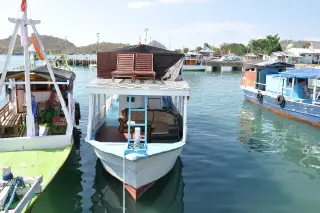
Labuan Bajo — Komodo National Park’s first generation of tourism moorings was built for small boats, with 25 buoys installed for local dive vessels from 1996 onwards, according to a 2002 report by The Nature Conservancy’s Indonesia Coastal and Marine Program compiled with the park authority.
The report describes a module of the conservation programme that “entailed the deployment and installation of 25 mooring buoys that are suitable for local boats carrying dive tourists,” and links this work to collaboration with the Indonesian park authority since 1996.
According to the same document, the October 2001–January 2002 project phase focused on installing the moorings listed in its site table, using the vessel MV Evening Star as a base and a stainless-steel pin system embedded in reef substrate.
Design for small boats, later expansion for big boats
The 2002 installation report states that the moorings were intended for “local boats carrying dive tourists,” and characterises the system as environmentally friendly for “small to medium sized boats.” It does not provide a precise maximum vessel length for these original buoys.
A separate description of the park’s mooring buoy programme notes that 25 Halas-brand mooring buoys were installed and emphasises that this system “is one of the most environmentally [friendly] mooring systems available for small to medium sized boats,” again associating the early buoys with relatively modest-sized tourism vessels.
Larger-vessel infrastructure came later. A briefing titled “Where the Buoys Are,” issued by PT Putri Naga Komodo, reports that by the completion of a second phase of installations the park had 12 “big boat” moorings rated for vessels up to 300 gross tonnes or 40 metres in length, as well as additional small-boat moorings, bringing the total number of buoys servicing the park to 32.
The same document explains that these big-boat moorings were added in two phases completed in 2006, and that they were explicitly intended to serve larger liveaboards and other sizeable vessels, distinguishing them from the earlier small-boat moorings installed under The Nature Conservancy’s programme.
Moorings and reef protection
The 2002 report presents mooring buoys as a tool to prevent tourism vessels from dropping anchors directly onto coral reefs, noting that anchors and chains can cause dragging damage in sensitive habitats.
It links the installation campaign to a broader 25-year management plan for the park, under which anchoring in certain zones is restricted to sandy bottoms or deeper waters and vessels are expected to use moorings where they are available.
The Nature Conservancy’s project documentation also highlights growing tourism pressure as a driver for these measures, citing rising visitor numbers and an increase in dive operators based in Labuan Bajo around the turn of the century.
Where the original buoys were placed
The 2002 installation report lists mooring sites in and around Komodo National Park and near Labuan Bajo, including Labuan Bajo Harbour and several locations in Northeast Komodo, East Komodo, Southeast Komodo and North Rinca.
The report notes that moorings were positioned close to dive and snorkelling sites, and that not every prepared anchoring pin necessarily had a buoy attached at the time of writing, making the number of physical buoys distinct from the number of installed pins.
A separate park document on stakeholder involvement in conservation planning records that “the Conservancy installed 25 mooring buoys in the Komodo area” and that this work was part of a broader effort to involve tourism operators in the mooring programme.
Later status of the mooring network
Subsequent reports indicate that the number of operational mooring buoys increased over time. A 2009 maintenance report describes 40 operational mooring buoys in Komodo National Park at that stage, compared with a much smaller number at the outset of that particular project.
PT Putri Naga Komodo’s “Where the Buoys Are” briefing similarly reports a total of 32 buoys following its second installation phase in 2006, including both big-boat and small-boat moorings.
Available web documents do not provide a current, park-wide inventory of moorings, nor do they specify the exact size range of vessels routinely using each buoy today.
Sources
Next story
Wuring Father and Son Found Adrift After Losing Contact on Selayar Voyage
Two Wuring fishermen reported missing en route from Sikka to Karumpa Island in South Sulawesi’s Selayar Islands were found alive adrift between Sukun…
Related