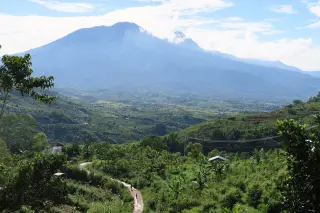

Komodo tourism study highlights culture, habitat and governance in Labuan Bajo
A 2026 journal article and recent conservation plans show how Komodo dragon tourism links local beliefs, national policy, habitat protection and development in and around Labuan Bajo, while leaving key questions about water, land and…
By Mukmin John
Editor: Mursyid Sonsang
· Event date: · 4 min read

Labuan Bajo — — Wildlife tourism around Komodo National Park is closely tied to conservation, local culture and regional development in western Flores, according to a 2026 study in the journal eTropic and Indonesian conservation authorities.
The eTropic article, published in April 2026, analyses how Komodo dragon tourism connects government-led development, local communities and conservation policy in and around Labuan Bajo. It highlights Komodo, Rinca, Nusa Kode and Gili Motang as central to the species’ range, and situates current tourism debates within wider questions of governance and community impacts.
Komodo tourism and community dynamics
The study frames Labuan Bajo and Komodo National Park as a linked tourism system in which wildlife, landscapes and human settlements are all part of the visitor experience. It argues that tourism brings conservation finance and regional economic activity, while also turning dragons and scenery into commodities, with potential ecological, cultural and social costs.
According to the authors, local beliefs that treat Komodo dragons as kin or relatives contribute to protection of the species, operating alongside formal state regulations. These cultural relationships, they write, form part of a broader conservation regime that includes park rules, village practices and national tourism planning.
The paper also describes local resistance to some tourism and development initiatives, linking protests and criticism to concerns over land, livelihoods and changing human–animal relations. It stresses that tourism policy can redistribute benefits and burdens unevenly, making questions of accountability central to how Labuan Bajo and Komodo are promoted to domestic and foreign visitors.
Where Komodo dragons live
Scientific and conservation sources agree that Komodo dragons have a highly restricted natural range in eastern Indonesia. Within Komodo National Park, they are confirmed on five main islands: Komodo, Rinca, Padar, Gili Motang and Nusa Kode. Several studies note that current populations on Padar are small compared with the strongholds on Komodo and Rinca.
Outside the park, Komodo dragons survive in scattered habitats along the western and northern coasts of Flores. Conservation plans and field surveys list Wae Wuul, Wolo Tadho, Riung and the Tujuh Belas Pulau (Seventeen Islands) recreation area among the principal reserves that still host wild populations.
The eTropic article identifies Komodo, Rinca, Nusa Kode and Gili Motang as the key islands in current tourism narratives, while noting that peripheral Flores locations are not promoted as equivalent visitor sites. Other conservation sources describe organised viewing for tourists at sites such as Loh Liang on Komodo Island and Loh Buaya on Rinca, where guided walks allow visitors to observe dragons under regulated conditions.
Governance and tourism strategy
The 2026 study situates Komodo National Park and Labuan Bajo within Indonesia’s national tourism strategy. Presidential Regulation No. 32/2018 on the acceleration of tourism development in Labuan Bajo–Flores designated the area as a strategic tourism destination and laid the basis for large-scale investment in infrastructure, marketing and destination branding.
Government communications subsequently classified Labuan Bajo as one of five “super-priority” tourism destinations, aligning conservation management with national objectives for visitor growth and regional development. This framework has brought park authorities, tourism planners and local governments into closer coordination, while creating new expectations about how revenues and burdens are shared among communities.
According to the eTropic study and recent conservation planning documents, Komodo tourism now operates at the intersection of species protection, coastal and island development, and community rights. The research emphasises that tourism is not inherently harmful or beneficial, but that its effects depend on how policies, investments and everyday practices shape relationships between people, dragons and landscapes.
Evidence and unanswered issues
For travellers, operators and educators, the sources underline the need for precise geography and careful attribution. Labuan Bajo on Flores, the islands inside Komodo National Park, and coastal reserves on Flores each face distinct conditions and governance arrangements.
The available research and official documents examined here do not map current village-level positions on clean water, agricultural land, employment, education or the continuity of ikat weaving. They also do not separately document how specific tourism businesses distribute benefits, support training or engage in cultural preservation.
Further reporting from community representatives, public agencies, park managers and companies would therefore be required to establish which villages or islands are presently most affected by infrastructure pressures, livelihood changes or cultural commodification.
Sources
- eTropic: Wildlife and Tourism in Labuan Bajo, Indonesia (PDF download)
- Komodo Survival Program – Distribution (English)
- In-Flores / KSDAE – Conservation Strategy and Action Plan for Komodo Dragon
- Komodo Guide – Labuan Bajo: Fishing Port to Top Destination
- International Varanid Interest Group – Varanus komodoensis
- Komodo dragon conservation analysis (Japanese language)
- Cabinet Secretariat of the Republic of Indonesia – Transformasi Labuan Bajo sebagai Destinasi Pariwisata Super Prioritas
- Komodo Survival Program / partner presentation on Komodo conservation and tourism
Next story
BMKG Warns of 3.5m Waves off South Sumba Through 19 September
Indonesia’s BMKG maritime station in Kupang warns of moderate to high waves across key Nusa Tenggara Timur routes from 17 to 20 September 2026, with t…
Related