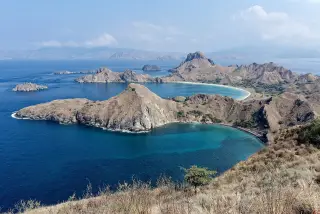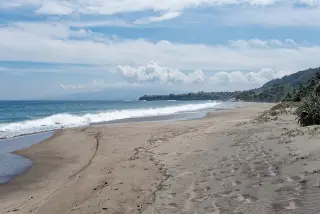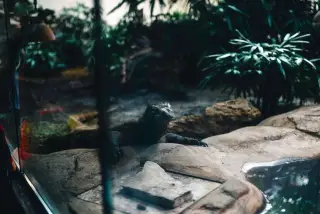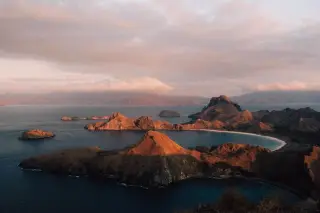

Marine waters make up about 67% of Komodo National Park
Figures from park information and conservation sources indicate Komodo National Park covers about 1,817 km², with roughly 603 km² of land and around 1,214 km² of marine area — meaning close to 67% of the park is sea.
Editor: Mursyid Sonsang
· Event date: · 4 min read Updated
Labuan Bajo — Marine waters make up roughly two-thirds of Komodo National Park’s area when calculated from widely cited figures of 1,817 square kilometres in total and 603 square kilometres of land, implying about 1,214 square kilometres of marine territory.
An information site dedicated to the park states that Komodo National Park “presently” covers 1,817 square kilometres, with 603 square kilometres of land across Komodo, Rinca, Padar and numerous smaller islands between Sumbawa and Flores. A conservation-focused site describing the park gives the same breakdown of 1,817 square kilometres in total, 603 square kilometres of land and 1,214 square kilometres of marine area, across three major islands and 26 smaller volcanic islands.
Using those figures, the implied marine share is 1,214 divided by 1,817, or around 66.8%. Rounded to the nearest whole percentage, that corresponds to about 67% of the park’s area being marine.
How the park’s area is described
The park information site lists the following figures for Komodo National Park’s extent:
- Total park area: 1,817 square kilometres
- Land area: 603 square kilometres
- Proposed additional land: 25 square kilometres on Banta Island
- Proposed additional marine waters: 479 square kilometres
It notes that if the proposed extensions on Banta Island and in surrounding waters were adopted, the combined surface area would reach 2,321 square kilometres. The conservation site similarly describes the park as encompassing 1,817 square kilometres in total, with 603 square kilometres of land and 1,214 square kilometres of marine territory.
Both sources situate Komodo National Park in the centre of the Indonesian archipelago, between Sumbawa and Flores in the border region between East and West Nusa Tenggara provinces, and emphasise that the park consists of Komodo, Rinca and Padar along with numerous smaller islands.
Marine share and broader protection
While the park-focused sources use 1,817 square kilometres as the total area, UNESCO documentation for Komodo’s World Heritage listing describes the inscribed property as covering 219,322 hectares (2,193.22 square kilometres), following an extension in 1984 to include an expanded marine area and part of mainland Flores. UNESCO’s Man and the Biosphere Programme describes the larger biosphere reserve surrounding the park as 1,118,003 hectares, with 785,052 hectares of marine area, meaning the sea accounts for about 70.2% of that reserve.
This difference in figures reflects the fact that various legal and conservation designations around Komodo refer to different spatial units: the national park as presented in popular information sources, the World Heritage property, and the broader biosphere reserve. In all of these, however, marine ecosystems account for a majority of the protected area.
UNESCO notes that in Komodo National Park the marine zone covers about 60% of the area and that its marine biodiversity is very high, highlighting strong currents, coral reefs and islets that make navigation challenging. These descriptions underline that safeguarding Komodo’s values requires management of both terrestrial habitats, including the range of the Komodo dragon, and extensive marine environments within the same protected-area framework.
Establishment and recognition
According to UNESCO’s periodic reporting on the site, Komodo National Park’s official protection began with a ministerial decree in March 1980 that declared a 72,000-hectare national park, which was later extended to 219,322 hectares in 1984 to include additional marine areas and a section of mainland Flores. The park was inscribed on the UNESCO World Heritage List in 1991. UNESCO further records that the surrounding biosphere reserve under the Man and the Biosphere Programme was accepted in 1977.
Taken together, these sources show that Komodo’s protected status has grown over time from a focus on the Komodo dragon to a wider mandate embracing terrestrial and marine biodiversity, with marine habitats now forming the majority of the area under international conservation recognition.
Sources
Read next
More on this story
Wildlife
Are Komodo dragons venomous? What the science says
Komodo dragons are venomous lizards. Research has identified venom glands and toxins that help them weaken prey by lowering blood pressure and prevent…
Latest in Komodo National Park
Today’s top story

Related