
Komodo tourism capacity grows faster than freshwater planning
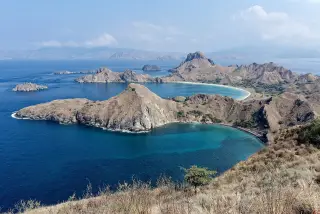
Recent studies model Komodo Island’s tourism capacity at 219,000 visits a year and Padar at 39,420, but available research and official information still lack a clear freshwater and wastewater strategy for communities and visitors.
Editor: Mursyid Sonsang
· Event date: · 5 min read Updated
Labuan Bajo — Komodo National Park’s tourism-capacity modelling is advancing faster than any publicly documented freshwater strategy, even as official information and tourism materials continue to describe limited water access for communities in and around the park.
A recent system-dynamics study in the Journal of Natural Resources and Environmental Management estimates an annual carrying capacity of 219,000 visits for Komodo Island and 39,420 visits for Padar Island, with Padar’s capacity potentially increasing to 2–2.5 times that level if services, safety and facilities are upgraded, according to Firmansyah and colleagues. Separate ecosystem-services work using the same visitor thresholds calculates ideal, standard and maximum annual visitor ranges of 219,000, 146,000 and 292,000 respectively for Komodo Island.
These figures describe tourism carrying capacity and environmental pressure rather than a water-demand forecast. The published texts reviewed do not set out how many litres are required per visitor, hotel room or household, nor do they present site-specific water-supply, storage or distribution plans for Komodo and Padar.
Documented freshwater shortages around the park
The park’s information page states that most villages in and around Komodo National Park have few freshwater facilities, particularly in the dry season, when water quality declines and illnesses such as diarrhea and malaria are common. It notes that residents of Mesa Island, described as having a population of around 1,500 at the time covered, have no freshwater source on the island and rely on water transported by boat in jerrycans from Labuan Bajo.
The same park information lists settlements on Komodo, Rinca, Kerora and Papagarang and describes local communities as largely dependent on fishing. Its demographic figures are internally inconsistent, referring to “nearly 4,000 inhabitants” within the park in one section and 3,267 people in another, and are not dated, indicating they are historical planning data rather than a current census.
The page also reports that Mesa households paid an average of Rp100,000 per month for transported freshwater in 2000, illustrating how water insecurity has imposed a direct cost on residents in past periods. More recent tourism material on Mesa Island similarly notes that residents still buy freshwater from vendors in Labuan Bajo because the island lacks its own freshwater source.
Visitor limits and climate projections
Firmansyah and colleagues’ 2023 system-dynamics study examines carrying capacity on Komodo and Padar using visitor numbers, ecosystem services and environmental constraints. It identifies an ideal annual visitor capacity of 219,000 for Komodo Island, with a standard capacity of 146,000 and a maximum of 292,000, and concludes that Padar Island can accommodate 39,420 visitors per year under current assumptions, rising to about 98,550 per year if facilities are upgraded.
Related ecosystem-services modelling projects that, without restrictions on visitor numbers, the value of ecosystem services lost at Komodo National Park could reach about US$727 million per year by 2045, whereas limiting visitors to the ideal range would reduce annual losses to around US$661,000 and allow restoration while maintaining ecosystem services. These studies collectively argue that tourism should be managed within environmental limits and that exceeding the park’s carrying capacity would erode ecosystem-service value over time.
Although the studies consider variables such as water supply as part of ecosystem services, they do not provide a detailed water-management blueprint for Komodo and Padar. The available texts do not specify drought triggers, minimum community allocations, desalination or rainwater targets, wastewater-reuse requirements, or funding responsibilities for water infrastructure in or around the park.
Regional tourism planning and infrastructure
Beyond Komodo Island and Padar, a 2023 study on Labuan Bajo and its surrounding tourism destinations calculates carrying capacity across attractions and urban infrastructure, including the Komodo National Park area. The authors report that, as of 2022, Labuan Bajo’s total tourism carrying capacity was about 8,230 tourists per day — equivalent to roughly 2.88 million visitors per year — following upgrades to infrastructure and facilities, and that this capacity had not yet been exceeded by actual visitor numbers.
The same study concludes that future visitor growth should be distributed beyond Komodo National Park to other destinations in East Nusa Tenggara and that environmental, economic and sociocultural carrying capacity need to be considered together in planning decisions. Separately, an urban carrying-capacity analysis of Labuan Bajo forecasts that land, electricity and water availability in the town’s urban area could face deficits by 2042, identifying zones that require priority treatment for sustainable tourism development.
Context
According to the park’s information page, Komodo National Park was established in 1980 and recognised as a World Heritage Site and Man and the Biosphere Reserve in 1986. The park covers terrestrial and marine areas around Komodo, Rinca and Padar and several smaller islands, with a total area of about 1,817 square kilometres in the figures provided.
The carrying-capacity and ecosystem-services studies collectively describe Komodo National Park as a globally significant conservation area where rising visitor numbers, climate pressures and limited freshwater availability require coordinated planning across tourism, community infrastructure and environmental management.
Sources
- Komodo National Park – About Komodo National Park
- Firmansyah et al. – Modelling of Carrying Capacity at Komodo National Park: System Dynamics Approach
- Fatina, Soesilo and Tambunan – Fulfilling Urban Infrastructure Standards to Increase the Carrying Capacity of Tourism Destination
- Firmansyah et al. – Ecosystem services and environmental benefit values on Komodo National Park
- Current Environmental Problems and Future Management of Komodo National Park – literature review
- Predicting urban carrying capacity to support sustainable tourism industry in the Urban Area of Labuan Bajo Flores
Read next
More on this story
Wildlife
Are Komodo dragons venomous? What the science says
Komodo dragons are venomous lizards. Research has identified venom glands and toxins that help them weaken prey by lowering blood pressure and prevent…
Latest in Komodo National Park
Today’s top story

Related