
Komodo dragon walking: how the giant lizard moves in the park
Komodo dragons walk on all fours with a side-to-side gait, can sprint in short bursts, and usually stay close to their home valleys inside Komodo National Park.
Editor: Mursyid Sonsang
· 3 min read
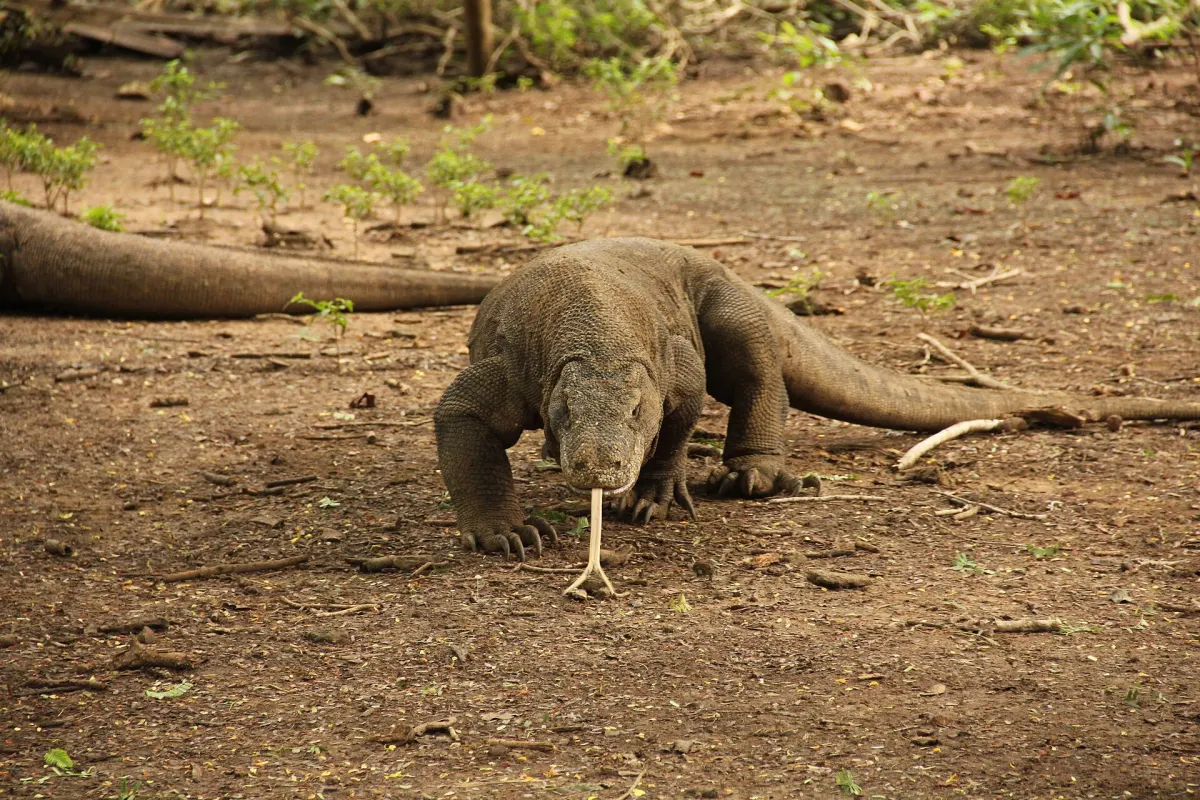
Komodo dragons walk on all fours with a side-to-side body motion, and they can also sprint in short bursts; in the wild, their movement is tied to territory use, foraging and the landscape of the islands where they live.
How does a Komodo dragon walk?
According to the Smithsonian’s National Zoo, the species uses an undulatory walk in which the head swings from side to side, while the body and tail also move laterally. A separate behavioural summary from the International Exotic Learning Center says the animal is quadrupedal and plantigrade, meaning it walks on all four limbs with the whole foot on the ground.
Research published in Media Konservasi describes the walking pattern as an alternating four-limbed gait: the right front foot steps, then the left hind foot, and then the pattern repeats. That same paper notes that walking and running are both performed by juvenile and adult Komodo dragons.
How fast can it move?
The International Exotic Learning Center lists a walking speed of 4.8 km/hr, and says running speed is 14-18.5 km/hr over short distances only. Facts and Details also reports that Komodo dragons can run at 11 mph, or 18 kph, for short bursts.
Those figures point to the same basic pattern: Komodo dragons are not built for long chases, but they can move quickly when they need to. The Smithsonian says the animal’s motion helps it sense the presence and direction of food.
Do young Komodo dragons move differently from adults?
Yes. The Media Konservasi study says hatchlings are the only life stage that perform jumping, while juveniles and adults are the life stages that walk and run. The same source says adult Komodo dragons walk, run and rest on the ground, while hatchlings and juveniles live in trees to avoid predation by adults.
That difference matters because it affects where visitors are most likely to see them in the park. Younger animals are more likely to be above ground level, while adults are more often encountered on the ground.
How far do Komodo dragons usually travel?
A 2018 study in Proceedings of the Royal Society B found that despite their physical ability to move long distances, Komodo dragons showed near complete dispersal restriction and rarely moved beyond the valleys where they were born or captured. The same study reports that some individuals averaged about 2.5 km per day, and that individuals could travel as far as 11 km per day.
The study also says home ranges were restricted entirely to local valleys and that exploratory terrestrial or aquatic movements were not recorded in the tracked animals. That helps explain why the species can be widely discussed as mobile, yet still remain surprisingly site-faithful.
Why does this matter inside Komodo National Park?
For visitors and park managers, walking behavior is not just a biological detail; it shapes where dragons are found, how they use valley terrain and why encounters often happen on land rather than in open water. The same movement patterns also help conservation teams understand how dragons use protected habitat across the islands.
The species’ movement is therefore best understood as powerful but localized: fast enough for short bursts, but usually tied to the valleys and terrain of its home range.
Sources
Read next
More on this story
Wildlife
Komodo dragon Rinca Island: why this island matters for sightings and conservation
Rinca Island is one of Komodo National Park’s key dragon habitats, with sources placing its wild Komodo population at about 1,300 or at 1,100-1,500 in…
Most read in Komodo National Park
Today’s top story

Related