
2021 study finds freshwater scarcity on Komodo and Rinca did not spur conflict
A 2021 qualitative study of Komodo and Rinca islands found that freshwater scarcity in Komodo National Park had not produced social conflict or large-scale migration, highlighting how cooperation and cultural norms help communities manage…
Editor: Mursyid Sonsang
· Event date: · 4 min read Updated
Labuan Bajo — A 2021 qualitative study of freshwater access in Komodo National Park found that scarcity on Komodo and Rinca islands had not led to community conflict or large-scale migration, according to research published in the Jurnal Ilmu Sosial dan Humaniora.
The study, titled “Air dan Konflik: Studi Ketersediaan Sumber Daya Air di Kawasan Taman Nasional Komodo,” set out to describe how residents access freshwater and to test theories that link natural-resource scarcity with conflict, including work by Homer-Dixon and Gleick.
Researchers worked in two locations inside the park—Komodo Island and Rinca Island—using qualitative interviews with community leaders, village heads, customary groups and fishing communities to understand local water use and governance.
The paper reports that limited freshwater supplies in these communities did not result in social conflict and did not trigger large-scale migration from water-scarce areas to other regions.
According to the authors, one key factor supporting this outcome was local cultural values that emphasize gotong royong, or mutual assistance, and trust among residents, which together underpin social harmony even under scarcity.
Findings on scarcity and social response
The study concludes that freshwater scarcity is real in Komodo National Park, but in the communities studied it has been managed through cooperation rather than competition.
This result differs from theoretical expectations that scarcity of natural resources tends to generate conflict, and the authors describe it as a new finding in the context of Homer-Dixon and Gleick’s conflict framework.
The researchers argue that strong social norms and collaborative practices help communities share limited water and avoid escalation into open disputes.
At the same time, the study underlines that scarcity continues to affect daily life. Earlier descriptions of the park note that many villages in and around Komodo National Park have few freshwater facilities, especially in the long dry season, and that residents in some settlements must bring water by boat from Labuan Bajo.
Study scope and key data
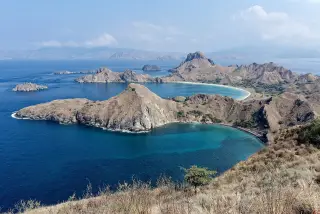
The research focused geographically on Komodo and Rinca islands within Komodo National Park and did not attempt to quantify the park’s overall water balance.
It used a qualitative approach, relying on interviews and social analysis rather than hydrological measurements.
The manuscript was received by the journal on 13 December 2020, accepted on 12 June 2021 and published on 31 August 2021 in Volume 10, Number 2 of the Jurnal Ilmu Sosial dan Humaniora.
The paper also places the case study in a broader context by noting that freshwater represents only a small share of the Earth’s total water—around 3 percent.
Physical backdrop: a dry island park
Komodo National Park lies in one of Indonesia’s driest regions, with annual rainfall generally reported between 800 and 1,000 millimetres, far below typical values for much of the archipelago.
The park experiences a long dry season of roughly eight months with little or no rain, influenced by monsoonal winds, and a shorter wet season when most rainfall occurs.
Descriptions of Komodo and Rinca islands characterize this pattern as a tropical savanna climate: low annual rainfall, a pronounced dry season and brief, intense wet-season rains that replenish temporary waterholes.
Low rainfall has historically limited agricultural development on the islands, leaving many residents dependent on fishing and small-scale collection of marine resources.
Baseline for tourism and conservation planning
The 2021 study offers a social baseline for understanding how communities in Komodo National Park have coped with freshwater scarcity without conflict, relying on cooperation and shared norms.
It also reinforces earlier observations that freshwater is a critical governance issue in the park, as limited supplies affect residents as well as tourism operations and conservation activities.
As tourism and infrastructure continue to develop, planners and researchers are likely to compare newer data on water use, rainfall and visitor numbers against this 2021 baseline to assess whether social arrangements can keep pace with changing demand.
Sources
- Jurnal Ilmu Sosial dan Humaniora (Undiksha) – PDF of “Air dan Konflik: Studi Ketersediaan Sumber Daya Air di Kawasan Taman Nasional Komodo”
- Komodo National Park information page – About Komodo National Park
- Envoist Journal – article citing Ahmad et al. (2021) on water and conflict in Komodo National Park
- Encyclopedia of Earth – Komodo National Park, Indonesia
- International parks and protected areas site – Komodo, Indonesia climate and ecology explainer
Read next
More on this story
Wildlife
Are Komodo dragons venomous? What the science says
Komodo dragons are venomous lizards. Research has identified venom glands and toxins that help them weaken prey by lowering blood pressure and prevent…
Latest in Komodo National Park
Today’s top story

Related