
Komodo National Park’s Marine Zone Spans About 1,214 Square Kilometres
Komodo National Park is legally defined as a combined land-and-sea conservation landscape, with scientific and official sources describing about 603 square kilometres of terrestrial habitat and roughly 1,214 square kilometres of marine…
· Event date: · 4 min read Updated
Labuan Bajo — Komodo National Park’s legal conservation mandate covers both land and sea, with scientific and official sources describing a protected landscape that spans roughly 603 square kilometres of terrestrial habitat and around 1,214 square kilometres of surrounding marine waters.
The 2021 review in the International Journal of Tropical Drylands notes that Komodo National Park “covers land area of more than 603 square kilometers and 1214 square kilometers of marine habitat.” It identifies protection of the Komodo dragon (Varanus komodoensis) and its natural habitat as the park’s primary purpose, while also highlighting the area’s potential for sustainable tourism.
International conservation databases give similar overall dimensions. An information sheet compiled for the Komodo World Heritage Site reports a total protected area of 219,322 hectares, including Komodo National Park at 173,300 hectares with a marine area of 130,177 hectares. A summary maintained by Indonesia’s Wildlife Institute and partners describes the marine environment of Komodo as extending across about 1,214 square kilometres, with the park’s overall surface area recorded as 219,322 hectares.
Land and sea biodiversity
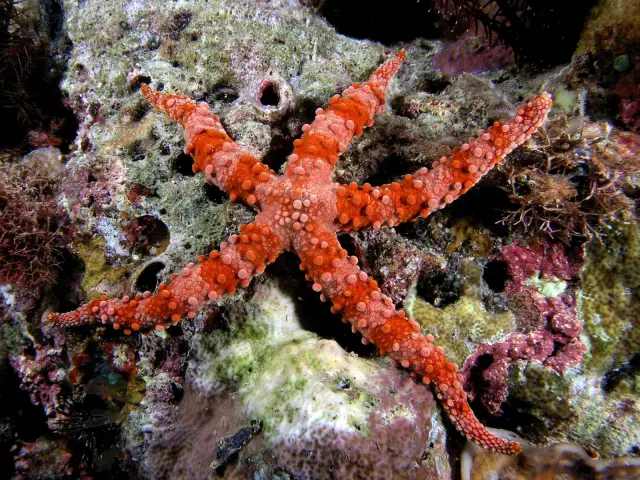
The 2021 review reports 277 animal species in the park’s land habitats. It describes the marine environment as still richer, citing 253 coral species, more than 1,000 fish species and 25 species of whales and dolphins in the national park’s waters. A separate technical profile of the Komodo World Heritage Site similarly records more than 1,000 fish species, some 260 species of reef-building coral and 70 sponge species in the wider marine area around the park.
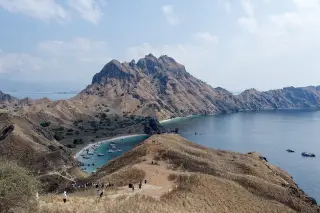
These figures underscore why management and policy discussions cannot focus solely on Komodo dragons. According to the review, the park consists of several small and medium-sized islands and a surrounding sea area that supports coral reefs, mangroves, seagrass beds, seamounts and semi-enclosed bays. Boat routes, anchoring areas, dive sites and traditional fishing grounds can therefore lie within the same conservation framework that protects terrestrial wildlife.
Zoning across land and sea
The park operates under a zoning system that distinguishes strict protection from tourism and traditional use. The 2021 review explains that the conservation-area designation was based on Minister of Forestry Decree No. 172/Kpts-II/2000, setting a total area of 173,300 hectares, with 114,801 hectares of water and 58,499 hectares of land. It states that the detailed zoning arrangement was approved through Director-General of Forest Protection and Nature Conservation Decree No. SK.21/IV-SET/2012.
According to that review, the Komodo National Park area is divided into a core zone of 34,311 hectares, a jungle (wilderness) zone of 66,921.08 hectares and a marine protection zone of 36,308 hectares, alongside several utilisation and traditional-use zones for both land and marine areas and a pelagic special-use zone.
An Indonesian zoning study based on the same decrees similarly lists a core zone, jungle zone, marine protection zone, tourism utilisation zones, traditional-use zones and special zones, confirming that management decisions distinguish different ecological and social functions inside the park.
Different ways of measuring the park
Not all published figures use identical boundaries or units. The 2021 review expresses the park’s extent as more than 603 square kilometres of land and 1,214 square kilometres of marine habitat. UNESCO’s World Heritage datasheet instead records Komodo National Park at 173,300 hectares within a broader 219,322-hectare World Heritage property that also includes protection forests and recreation parks on mainland Flores.
Other summaries aimed at visitors draw on these official designations but present rounded figures. A global national parks overview describes Komodo National Park as covering about 1,733 square kilometres of land and sea. A regional conservation profile likewise notes that the marine environment associated with the park extends across roughly 1,214 square kilometres.
For travellers, divers and policymakers, the practical point is that Komodo is a combined land-and-sea conservation landscape. Marine protection — including coral reefs, fish populations and migratory whales and dolphins — is embedded in the park’s zoning and legal status, rather than being an optional add‑on to the terrestrial Komodo dragon habitat.
Sources
- International Journal of Tropical Drylands – "Reviews: Komodo National Park as a conservation area for the komodo species (Varanus komodoensis) and sustainable
- Komodo National Park as a Conservation Area For the Komodo Species and Sustainable Ecotourism (PDF)
- Komodo National Park – World Heritage Site datasheet (UNEP-WCMC)
- UNESCO World Heritage List – Komodo National Park (ID 609)
- Komodo National Park – Global Alliance of National Parks overview
- Indonesian Ministry-related study on Komodo National Park zoning (Sosek KP journal article)
- UIN Jakarta thesis on community perceptions and Komodo National Park zoning
- Zoning explanation for Komodo National Park in Indonesian policy report
- Komodo National Park basic webpage – Wildlife Institute of India collaboration
Read next
More on this story
Wildlife
Reports highlight Komodo National Park’s wildlife and marine habitats
Reports describe Komodo National Park as a habitat for Komodo dragons and yellow-crested cockatoos, with coral reefs, fish and larger marine animals i…
Latest in Komodo National Park
Today’s top story
Related