
2021 literature review finds mixed impacts of development in Komodo area
A 2021 academic literature review by Universitas Ivet researchers summarizes positive and negative environmental, economic and socio-cultural impacts linked to development around Komodo.
· Event date: · 5 min read Updated
Labuan Bajo — A 2021 literature review of 20 published articles found that development in and around Komodo National Park has brought both positive and negative impacts across environmental, economic and socio-cultural dimensions, while not providing direct proof that specific construction projects caused pollution or declining water quality, according to the authors.
The article, titled Dampak Positif dan Negatif Pembangunan di Komodo dan Sekitarnya: Sebuah Tinjauan Literatur, appeared in the Envoist Journal (Environmental Sustainability Journal) in 2021 and was written by Ray March Syahadat and Rizal Ichsan Syah Putra of Universitas Ivet.
In their abstract, the authors state that development in Komodo and surrounding areas has generated both benefits and harms and call for further research on these impacts. The paper synthesizes existing studies on tourism and development around Komodo rather than presenting new field measurements or project-level environmental impact assessments.
What the review examined
The review collected and described research concerning Komodo National Park and nearby areas in Manggarai Barat Regency. It drew on 20 journal articles that address tourism, social and economic change, ecological concerns and policy debates related to development around Komodo.
According to references to the paper in other academic works, Syahadat and Syah Putra’s article is classified as a literature review that examines environmental, economic and socio-cultural dimensions of development in the Komodo area.
The selected literature includes studies on tourism’s effects on local communities, changing livelihoods and social structures in Labuan Bajo and the surrounding region, discussions of environmental governance and sustainable development, and work on community participation in tourism and ecotourism initiatives.
The authors group the findings into three main dimensions: environmental impacts, economic benefits and costs, and socio-cultural change. This framing allows comparison of different types of consequences, but it does not isolate or quantify pollution from individual projects.
What it can—and cannot—show
The review’s conclusions indicate that development and tourism around Komodo have brought both positive outcomes, such as increased economic activity, and negative pressures, including ecological and social risks, based on the earlier studies it cites.
However, the article does not report its own sampling or laboratory analysis of coastal waters and does not present original measurements of nutrients, sewage, sediment, plastics, chemical pollutants or other indicators in the marine environment. It instead relies on previously published research and policy documents.
As a result, the paper does not establish a direct cause-and-effect relationship between specific construction projects and measured declines in water quality at named locations. Any link between tourism infrastructure and environmental degradation in the text is based on secondary studies and remains general rather than site-specific.
The authors close by recommending further research and outlining several directions for future study on sustainable development, ecological impacts and community participation, underlining that existing knowledge remains incomplete.
Location and context
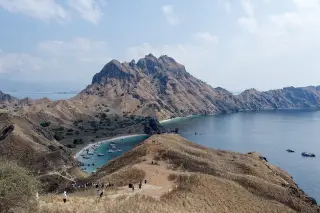
Komodo National Park is located between the islands of Sumbawa and Flores in the Indonesian archipelago and comprises three main islands—Komodo, Rinca and Padar—as well as numerous smaller islands and surrounding marine areas.
The park was established in 1980 to protect the Komodo dragon, Varanus komodoensis, and later expanded to safeguard broader terrestrial and marine biodiversity. It covers roughly 1,733–1,817 square kilometres, including both land and sea, according to international conservation data and UNESCO-related sources.
UNESCO inscribed Komodo National Park as a World Heritage Site in 1991 for its exceptional natural beauty and biodiversity, especially its population of Komodo dragons. The park’s islands are of volcanic origin and include savanna landscapes, coral-rich waters and strong tidal currents that contribute to complex marine ecosystems.
Why evidence needs to be specific
Because Komodo National Park consists of multiple islands and coastal zones, findings from one bay, reef or village cannot automatically be generalized to the entire protected area. Robust claims about pollution or water-quality change require clearly documented sampling locations, dates, indicators and potential sources, ideally within project-level environmental assessments or long-term monitoring programmes.
The 2021 literature review helps map the range of concerns and perceived impacts associated with tourism and development around Komodo, particularly after the park’s international recognition and expansion of tourism promotion. It does not, on its own, answer whether a particular construction project has altered water circulation, contaminated a specific bay or exceeded ecological limits.
For policymakers, investors and residents, the practical implication is that the review is best used as a guide to existing debates and research themes, while more targeted environmental monitoring and impact assessments are still needed to document any site-specific changes in coastal water quality.
Sources
- Envoist Journal (Environmental Sustainability Journal) – "Dampak Positif dan Negatif Pembangunan di Komodo dan Sekitarnya: Sebuah Tinjauan Literatur" (PDF)
- Jurnal Istiqomah / Merdeka – "Pembangunan Berkelanjutan Dan Krisis Ekologi" (PDF)
- UIN Sunan Kalijaga digital repository – "Resiliensi Perempuan dan Sumber Penghidupan Baru" (thesis PDF)
- UNEP-WCMC World Heritage Datasheet – Komodo National Park
- UNESCO World Heritage Centre – Komodo National Park (Site 609)
- Universitas Katolik Parahyangan repository – thesis bibliography citing Syahadat & Syah Putra 2021
- Komodo National Park – Wikipedia
- International Parks – "Komodo - Indonesia"
- World Heritage Memory Net – Komodo National Park
Read next
More on this story
Wildlife
Reports highlight Komodo National Park’s wildlife and marine habitats
Reports describe Komodo National Park as a habitat for Komodo dragons and yellow-crested cockatoos, with coral reefs, fish and larger marine animals i…
Latest in Komodo National Park
Today’s top story

Related