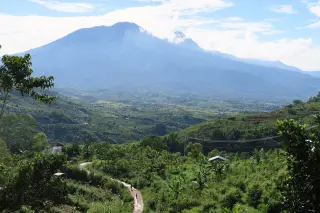

Flores quake leaves West Manggarai communities facing long recovery
A magnitude 7.7 earthquake and tsunami warning struck Indonesia’s Flores region on 15 August 2026, causing deaths, displacement and building damage across regencies including West Manggarai.
Editor: Mursyid Sonsang
· Event date: · 4 min read
Labuan Bajo — A powerful magnitude 7.7 earthquake struck the Flores region of East Nusa Tenggara on Saturday, 15 August 2026, collapsing buildings, triggering a tsunami warning and displacing thousands of residents across several regencies, according to Indonesia’s Meteorology, Climatology and Geophysics Agency (BMKG) and national disaster officials. While detailed village-level reporting from Cunca Lolos in West Manggarai is not yet available, the broader damage pattern in Manggarai and surrounding areas suggests rural communities along the Trans-Flores road are facing a prolonged recovery.
BMKG reported that the main shock struck at 04:58 local time with an updated magnitude of 7.7 and a shallow depth of around 10–15 kilometres, linked to thrust faulting on the Flores Back-Arc system. The agency issued a tsunami warning minutes after the earthquake, later ending it once monitoring stations confirmed only moderate tsunami heights, with the highest recorded at around 1.6 metres in Pota, East Manggarai.
National and international assessments indicate severe impacts across Flores. BMKG and humanitarian briefings cite at least 53 deaths and more than 130 injuries across affected areas, including Manggarai Barat (West Manggarai), Manggarai, East Manggarai and Sikka. Separate reporting by Indonesia’s national disaster agency BNPB described nearly 12,800 people displaced as of the Monday following the quake, many sheltering in temporary tents and public facilities in multiple towns on Flores.
Damage across Flores and Manggarai
BMKG’s summary of the event notes structural damage ranging from light to severe in West Manggarai, Manggarai, East Manggarai and Sikka, with affected buildings including houses and public facilities. A humanitarian alert issued in late August similarly highlights collapsed homes, damaged infrastructure and ongoing aftershocks that complicated search and rescue operations and delayed the return of residents to their neighbourhoods.
The shallow depth and strength of the earthquake produced intense shaking across northern Flores, with reports of landslides and blocked roads in several districts. Rescue teams operating from towns such as Maumere and Ruteng described working through rubble and earth to reach isolated communities, as aftershocks continued in the days and weeks after the main shock.
Although these assessments do not single out Cunca Lolos by name, West Manggarai is among the regencies identified by BMKG as experiencing damage, suggesting that villages along the Labuan Bajo–Ruteng section of the Trans-Flores road have faced structural impacts and displacement. For travellers, this means stretches of the route between Labuan Bajo and Ruteng pass through areas where reconstruction and temporary shelter remain visible.
Aftershocks and evolving risk
In the month following the earthquake, BMKG recorded more than 15,000 aftershocks, with magnitudes ranging from 0.9 to 6.2, before activity began to taper. Agency officials have urged residents in affected regencies, including those in Manggarai and West Manggarai, to remain cautious around damaged structures and steep slopes even as the most intense shaking subsides.
BMKG’s analysis links the event to active tectonic structures north of Flores, and the agency has indicated that ongoing monitoring will inform guidance on rebuilding and future land-use planning in coastal and hillside communities.
Recovery and assistance
National disaster authorities report that emergency response efforts in Flores have included search and rescue operations, the establishment of temporary shelters and the distribution of basic supplies to displaced residents. As of mid-September, humanitarian briefings describe a transition from immediate rescue toward longer-term recovery, including housing assessments, repair of public facilities and restoration of transport links.
The scale of displacement and damage at the regency level indicates that rural communities such as those in Mbeliling subdistrict will likely face a multi-month recovery process, balancing reconstruction of homes with restoration of agricultural livelihoods. However, publicly available national and international reports so far do not provide verified figures on the number of damaged houses, casualties or specific assistance received in Cunca Lolos itself.
For visitors and investors looking toward Flores in the wake of the August 15 earthquake, official data underline both the severity of the disaster and the ongoing commitment to recovery planning. BMKG and BNPB continue to publish technical updates and impact assessments that will shape reconstruction priorities in West Manggarai and neighbouring regencies.
Sources
- BMKG press release on Flores M7.7 earthquake and tsunami
- ACT Alliance humanitarian alert on Indonesia Flores earthquake
- NPR report on rescuers after Indonesia Flores earthquake
- Boston Herald / AP report on magnitude 7.7 earthquake off Indonesia
- The Daily Star report on displacement after Flores earthquake
- Observer Indonesia article on aftershocks and BMKG field survey
- The Guardian report on powerful earthquake in eastern Indonesia
Next story
Manggarai Barat’s own Kodim marks first year as tourism hub grows
Military District Command 1630/Manggarai Barat marked its first anniversary on 19 September 2026, a year after regional commander Piek Budyakto formal…
Related