
Study projects Komodo water demand rising to 58,070 m³ by 2045
A 2023 system-dynamics study projects combined tourism and domestic water demand in the Komodo and Padar Island areas rising from 40,622 cubic metres in 2021 to 58,070 cubic metres by 2045, outstripping modelled water-absorption potential…
· Event date: · 4 min read Updated
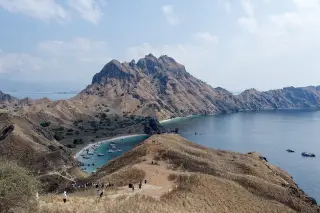
Labuan Bajo — Water demand linked to tourism and domestic use in the Komodo Island and Padar Island areas is projected to rise from 40,622 cubic metres in 2021 to 58,070 cubic metres in 2045, according to a system-dynamics carrying-capacity study published in the Journal of Natural Resources and Environmental Management.
The study, led by Irman Firmansyah, models how tourism growth and population change could affect resources and ecosystems in parts of Komodo National Park. It estimates water demand and the environment’s capacity to absorb water under different development scenarios, rather than reporting current measured consumption.
Projected demand and absorption
In its projection results, the paper states that water demand in the Komodo and Padar Island areas will reach 40,622 cubic metres in 2021 and 58,070 cubic metres in 2045. The authors attribute rising domestic water demand to an increase in residents in Komodo Village, as well as growing water use from the park and its visitors.
The same model estimates that water-absorption potential that can be utilized in those areas is 43,226 cubic metres in 2021 and 39,251 cubic metres in 2045. In the study’s framing, demand describes how much water users may require, while absorption potential refers to the capacity of the local environment and water system to receive and process water.
By 2045, the projected demand of 58,070 cubic metres exceeds the modelled absorption potential of 39,251 cubic metres, highlighting a possible gap between future use and environmental capacity if development continues without additional safeguards.
Tourism carrying capacity
The paper calculates what it calls an ideal annual number of visits based on carrying capacity: 219,000 visits per year for Komodo Island and 39,420 visits per year for Padar Island. According to the article, visit numbers could still rise by about two to 2.5 times within the model’s conditions, but higher visitation would increase pressure on water resources and ecosystems.
The ideal visit figures are used alongside water indicators and other variables to explore how different tourism and development choices could affect Komodo dragons, prey species, vegetation, emissions and local livelihoods over time. The model does not provide direct measurements of how much water hotels, boats or individual tourism facilities currently consume.
Komodo dragon projections and climate
Under a scenario that emphasises low-carbon development and conservation, the study estimates that Komodo National Park could support around 4,000–4,500 Komodo dragons by 2045, with roughly 2,500 individuals on Komodo and Padar Islands. In a contrasting scenario without low-carbon policies, the model suggests that Komodo dragon numbers on those two islands could decline to about 800–900 individuals by 2045.
The paper also projects an increase in temperature of approximately 0.8 degrees Celsius by 2045, which it links to broader climate trends and the implications for habitat conditions in the park. These projections are presented as model outputs, not as official forecasts by government agencies.
Implications for planning
The authors describe carrying-capacity assessments as a tool for sustainable tourism management in Komodo National Park. They argue that planning based on system-dynamics modelling can help authorities and operators understand how visitor numbers, infrastructure choices and land use could interact with water demand, absorption potential and biodiversity.
Because the projected water demand of 58,070 cubic metres by 2045 is higher than the modelled absorption potential, the study highlights the need for careful management of water supply, wastewater treatment and settlement growth if tourism continues to expand in the Komodo and Padar Island areas.
Komodo National Park, which includes Komodo, Padar and other islands and surrounding marine areas, was declared a national park in 1980 and later inscribed as a UNESCO World Heritage Site, according to international conservation data. The park’s global significance for Komodo dragons and marine biodiversity has made it a major tourism destination, reinforcing the importance of aligning future visitor growth with the limits indicated by water and ecosystem models.
Sources
Read next
More on this story
Travel & Access
BMKG warns of thunderstorm risk in Labuan Bajo on 1 November
BMKG forecasts thick cloud, rain and a chance of thunderstorms in Labuan Bajo on Sunday, 1 November 2026. Nearby waters also face a warning of wind gu…
Latest in Komodo National Park
Today’s top story
Related