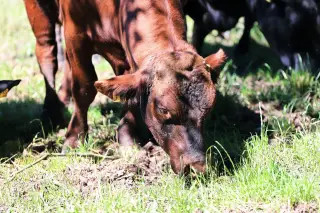

Lewotobi evacuees in Konga plant watermelons beside temporary shelters
Nearly two years after Mount Lewotobi Laki-Laki erupted, evacuees living in temporary housing in Konga, East Flores, have begun cultivating watermelons beside the shelters as a way to stay productive and explore future income opportunities.
Editor: Mursyid Sonsang
· Event date: · 4 min read Updated

Konga, East Flores — Residents displaced by the eruption of Mount Lewotobi Laki-Laki are cultivating watermelons beside their temporary housing in Konga, using small-scale farming as a way to remain productive while awaiting permanent resettlement.
Local newspaper Flores Pos reported that members of the Peten Lewo community group planted watermelon seedlings on land around the huntara, or temporary shelters, in mid-June 2026, nearly two years after moving into the site.
The article described the initiative as both a way to fill time in the displacement camp and an effort to open up future income opportunities, although it did not provide figures on production volume or sales.
Learning through the first harvest
Flores Pos reported that the group carried out its first watermelon harvest together with the Catholic Religious Extension Team serving Lewotobi evacuees from the East Flores branch of Indonesia’s Ministry of Religious Affairs.
According to the report, Peten Lewo members said the harvest demonstrated that their efforts could produce tangible results in the temporary-housing area and offered practical lessons for future planting cycles.
The group’s chairman, Andreas Tobi, told Flores Pos that the first harvest brought happiness to members and gave them experience they could use to improve cultivation in the next cycle.
Flores Pos noted that the residents faced difficulties in maintaining the crop, including pest management and care of the plants, and that the group planned to apply the lessons from this first season to subsequent plantings.
Life extended in temporary shelters
The watermelon initiative takes place against a prolonged displacement that began after the eruption of Mount Lewotobi Laki-Laki in early November 2024.
Indonesia’s National Search and Rescue Agency (Basarnas) reported that by the evening of 4 November 2024, 1,403 people had been evacuated due to the eruption, including 787 evacuees in Konga and 606 in Bokang.
The Ministry of Religious Affairs office in Sikka later stated that the 4 November 2024 eruption affected six villages in Flores Timur and prompted the evacuation of around 10,777 residents across Flores Timur and Sikka regencies.
By mid-2026, media reports indicated that many Lewotobi survivors were still living in temporary shelters while waiting for permanent housing.
An in-depth report by the outlet Floresa.co in June 2026 noted that nearly two years after the major eruption, thousands of residents remained displaced, with around 250 families in government-built temporary housing and hundreds of other families taking shelter independently with support from a housing allowance.
The same report described temporary shelters in Konga facing problems such as flooding and leaking roofs during heavy rain, underscoring the pressure on families as they wait for permanent relocation.
In July 2026, regional media coverage of a visit by the head of Indonesia’s National Disaster Management Agency (BNPB) to Konga highlighted continued efforts to support evacuees and prepare longer-term housing solutions.
Recovery efforts and unanswered economic questions
For residents in Konga’s temporary settlement, cultivating watermelons around the huntara offers a way to stay active and build skills while formal reconstruction and relocation plans proceed.
The Flores Pos article framed the farming as an activity that can eventually support livelihoods, but it did not detail whether the first harvest has yet reduced residents’ dependence on humanitarian assistance or provided stable income.
Other media reports on Lewotobi survivors have described broader efforts by authorities to prepare permanent housing sites and open access roads, but they likewise do not specify how much income displaced households currently earn from small-scale farming initiatives in Konga.
What can be confirmed from available reporting is that, nearly two years after the November 2024 eruption, many Lewotobi evacuees remain in temporary accommodation and are experimenting with agriculture near the shelters as part of their longer road to recovery.
Sources
Read next
More on this story
Travel & Access
East Flores Timpora meeting bolsters foreign‑visitor monitoring
A coordination meeting led by the Sikka Class II Immigration Office in East Flores on 17 September 2026 brought local government, law‑enforcement and…
Latest in Flores & Beyond
Today’s top story
Related