

How healthy are Komodo National Park’s coral reefs?
Official monitoring shows sharply different reef conditions at two Komodo sites, while the park’s biodiversity figures reveal why local observations matter for divers and conservation readers.
By Pandi Muktar
Editor: Mursyid Sonsang
· 3 min read
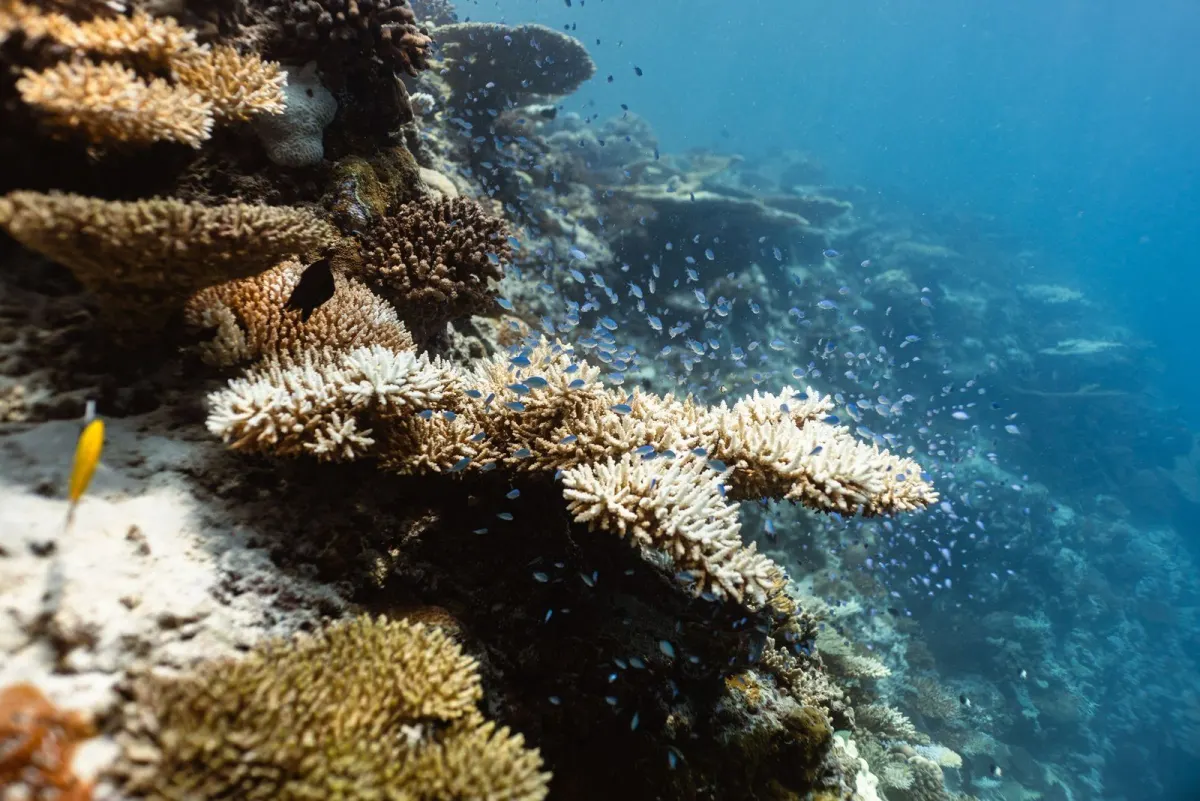
Komodo National Park’s reefs are not uniformly healthy: official monitoring found 71.5% healthy reef condition at Siaba Besar but 32% at Mauwan in observations conducted in April 2020. The results show why a dive site’s local condition matters more than a park-wide label.
How healthy are Komodo’s coral reefs?
The park’s marine environment includes coral reefs, mangroves, seagrass beds, seamounts and semi-enclosed bays. The park’s environmental assessment identifies more than 1,000 fish species, at least 260 reef-building coral species and 70 sponge species in these habitats, according to the Komodo National Park environmental assessment.
Those biodiversity figures describe the range of life recorded across the park; they are not a measurement of present-day coral condition at every dive site.
Why do Siaba Besar and Mauwan show different results?
Komodo National Park’s diving team surveyed waters around Siaba Besar and Mauwan from 13 to 17 April 2020 using reef-health monitoring guidance and underwater photo transects, according to the Ministry of Environment and Forestry’s conservation agency, KSDAE.
At Siaba Besar, healthy reef condition reached 71.5%. Hard coral accounted for 64.5% of cover and dead coral for 14%, according to KSDAE.
At Mauwan, healthy reef condition was 32%. The survey recorded rubble at 63%; within the reported cover figures, rubble accounted for 44.5% and hard coral for 23%, according to KSDAE.
What do the figures mean for divers?
The figures are site-specific observations, not a guarantee for every reef, route or season. They also measure reef condition rather than visibility, current strength, wave height or the safety of a particular boat trip.
For marine readers, the practical meaning is that “Komodo reefs” should not be treated as one uniform system. A site with higher hard-coral cover and a site dominated by rubble can exist within the same national park.
How is reef health monitored?
The 2020 assessment used underwater photo transects along a 100-metre line placed parallel to the shoreline, according to KSDAE. The method is designed to document reef structure and condition at the observation site.
The park’s monitoring programme also reports intensive coral-reef surveys at 185 sites conducted every two years, according to Komodo National Park’s monitoring and research information. That longer-running programme is intended to map damage and other threats across the park rather than replace local site assessments.
What should be taken from the monitoring?
The clearest answer is variation: official observations recorded substantially different reef conditions at Siaba Besar and Mauwan. The park’s biodiversity remains extensive, but biodiversity totals and reef-health percentages answer different questions and should not be conflated.
Sources
Read next
More on this story

Wildlife
How wildlife monitoring protects Komodo National Park’s species
Scientific monitoring in Komodo National Park tracks dragons, manta rays, turtles, reefs and fish through repeated surveys, helping managers measure w…
Latest in Marine & Diving
Today’s top story

Related