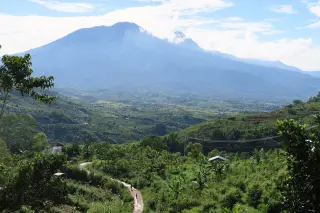

Co-operatives keep Flores finance moving after 7.7 quake
Savings-and-loans co-operatives KSP Kopdit Pintu Air and Komida have kept services running after the 7.7-magnitude Flores earthquake of 15 August 2026, adapting to aftershocks and damaged infrastructure while the full financial impact on…
Editor: Mursyid Sonsang
· Event date: · 4 min read

Labuan Bajo — Savings-and-loans co-operatives KSP Kopdit Pintu Air and Komida have kept services running for communities on Flores Island after the 7.7‑magnitude earthquake of 15 August 2026, adapting operations as aftershocks and damaged infrastructure disrupt daily life, according to Indonesia’s Meteorology, Climatology and Geophysics Agency (BMKG) and cooperative networks.
The earthquake struck at 05:58 WITA (UTC+8) on Saturday, 15 August 2026, off the north coast of Flores in East Nusa Tenggara province, at a depth of about 15km and roughly 30km northeast of Mbay in Nagekeo regency, BMKG reported in its technical briefing on the event.
BMKG identified the shock as thrust‑fault activity along the Flores Back‑Arc Thrust and issued an early tsunami warning minutes after the quake, later lifting it once sea‑level monitoring showed conditions had stabilised.
Human impact and ongoing aftershocks
Indonesia’s National Disaster Management Agency (BNPB) and international situation overviews described a rapidly evolving emergency in the days after the main shock.
A situation overview published on 18 August 2026 noted that confirmed fatalities had risen to 68 and injuries to more than 200 by Monday, 17 August, while over 19,000 people were sheltering in tents, evacuation centres and makeshift camps three days after the quake.
By Thursday, 20 August, BNPB told international media that 75 people had been confirmed dead, 907 injured and nearly 93,000 displaced, with persistent aftershocks prompting residents to leave damaged or potentially unsafe buildings.
BMKG and subsequent field reports recorded thousands of aftershocks in the weeks following the main event, shaping local decisions about when it was safe to resume indoor activities and normal economic life.
Co‑operatives adjust operations
Against this backdrop, local savings‑and‑loans co‑operatives began adapting how they serve members.
Komida, a microfinance co‑operative focused on low‑income women, reported that a portion of its staff in East Nusa Tenggara had not yet been able to return to work as of the second week after the earthquake, due to damaged roads, disrupted transport and safety concerns linked to continuing tremors, according to a feature on co‑operatives’ role in recovery.
The same report said that KSP Kopdit Pintu Air, which serves farmers and fishers in the region, kept its Flores branches open and continued offering savings, loans and other member services, but shifted day‑to‑day activities from main office buildings to emergency service points set up in branch courtyards while aftershocks continued.
The outdoor arrangements were designed to maintain access to cash and financial services while limiting the risk of staff and members being inside structures that might be weakened by the quake and subsequent tremors.
Micra Indonesia executive director Alfi Syahrin said partner organisations in the affected areas were prioritising staff and member safety while working to build a reliable picture of the disaster’s economic effects, including damage to livelihoods based on farming, fishing and small‑scale enterprises.
Financial resilience and unanswered questions
For households whose income depends on local agriculture, fisheries and informal activity, nearby co‑operatives are a primary channel for savings, working capital and emergency borrowing.
Observers argue that member‑owned financial institutions can support disaster recovery because they combine local staff and relationships with established savings and lending systems.
However, the available reporting on Pintu Air and Komida focuses on operational continuity and safety measures rather than detailed balance‑sheet impacts.
It does not specify how many members or branches suffered physical damage, nor does it confirm whether loan collections or disbursements were formally suspended, whether repayment holidays or fee waivers have been introduced, or whether either organisation has faced unusual liquidity pressure or rising arrears.
The reports likewise do not provide quantified estimates of members’ financial losses, outstanding loan portfolios in the affected regencies or the scale of any emergency‑loan demand.
As government and humanitarian agencies continue to update casualty and displacement figures and BMKG refines its analysis of the seismic sequence, the long‑term financial effects on local co‑operatives and their members remain a key question for both recovery planners and communities on Flores.
Sources
- BMKG – Gempa Flores M7,7 Jadi Momentum Penguatan Mitigasi Bencana Berbasis Sains dan Teknologi
- ACT Alliance – Alert note: Indonesia Earthquake August 2026
- Xinhua – Death toll from Indonesia's magnitude-7.7 quake rises to 75
- Data Friendly Space – Indonesia Earthquake: Situation Overview
- The News Cooperative
Next story

Bank NTT sets two credit-relief schemes after Flores earthquake
Bank NTT has prepared two credit-relief schemes for customers affected by the 15 August 2026 Flores earthquake, but as of 7 September no borrowers had…
Related